
Oak Ridge City Directory Holdings
Oak Ridge has several useful directory-style collections, not one documented, continuous set of annual books. The most certain general city-directory lead is a 1960 title and year reported by an established genealogy index. The Library of Congress also identifies an Anderson County criss-cross series that includes Oak Ridge and Clinton. The Oak Ridge Room, ContentDM, Clinton Public Library, and the Anderson County Historical Society add different parts of the record trail. Each collection needs its own date and access note.
| Local collection | Verified coverage | Oak Ridge keeper | How it can be used |
|---|---|---|---|
| Oak Ridge Room | Established 1986; directory runs not published | Oak Ridge Public Library | Staff-assisted local-history research |
| Oak Ridge City Directory | 1960 title and year reported | Library and genealogy lead | Verify the original volume, publisher, and extent |
| Anderson County criss-cross | 1989-1995, including Oak Ridge and Clinton | Library of Congress guide and local library | Reverse address-to-occupant research |
| Hospital personnel directory | 1945 | Oak Ridge Public Library ContentDM | Named institutional and date context |
| Oral histories and yearbooks | Collection exists; individual ranges vary | ContentDM and Oak Ridge Room | Browse online or ask library staff |
| The Oak Ridger catalog record | 1949-current | Library of Congress and ORPL | Notices, obituaries, and address clues |
The published research does not verify a full Oak Ridge run, publisher sequence, or final print year. A missing search result can therefore mean that a volume has not been digitized, is in a staff-attended room, or falls in a gap between known leads. Record the year actually consulted instead of assuming that nearby years exist.
Oak Ridge City Directory Desk
The Oak Ridge Public Library is the central local-history stop. It opened for wartime relocated residents in 1944, moved to its current building in 1970, and dedicated the Oak Ridge Room in 1986. The room collects, catalogs, and preserves Oak Ridge history and works by local authors. Its policy requires staff attendance for use, so call the local-history specialist at 865-425-3467 before a visit.
Bring a name, street, and year range. Staff can help identify city directories, reverse or criss-cross volumes, telephone books, yearbooks, obituary indexes, vertical files, oral histories, newspapers, and photographs. The catalog gives a starting point, but the public pages do not state a shelf-by-shelf directory inventory. That distinction matters when a particular year is the goal.
See the Oak Ridge Public Library's local-history information before arranging a research visit.
The Oak Ridge Room is a staff-assisted collection rather than a promise that every historical directory has a public online scan.
Oak Ridge Digital Directory Collections
Oak Ridge Public Library's ContentDM collections add sources that ordinary printed listings cannot supply. They include oral-history recordings and materials, manuscripts, periodicals, photographs, yearbooks, and a Department of Energy photograph collection with more than 1,000 World War II-era images from about 1943 through 1949. Item metadata can provide a title, date, description, subject, and collection setting before a researcher requests a related physical source.
The digital collection is especially useful when a wartime name is tied to an institution, neighborhood, or event. Oral histories may explain a person or place when a general resident listing is unavailable. A photo or recorded recollection still needs corroboration when the question concerns a precise address or family relationship.
Browse the Oak Ridge Public Library digital collections for the online holdings.
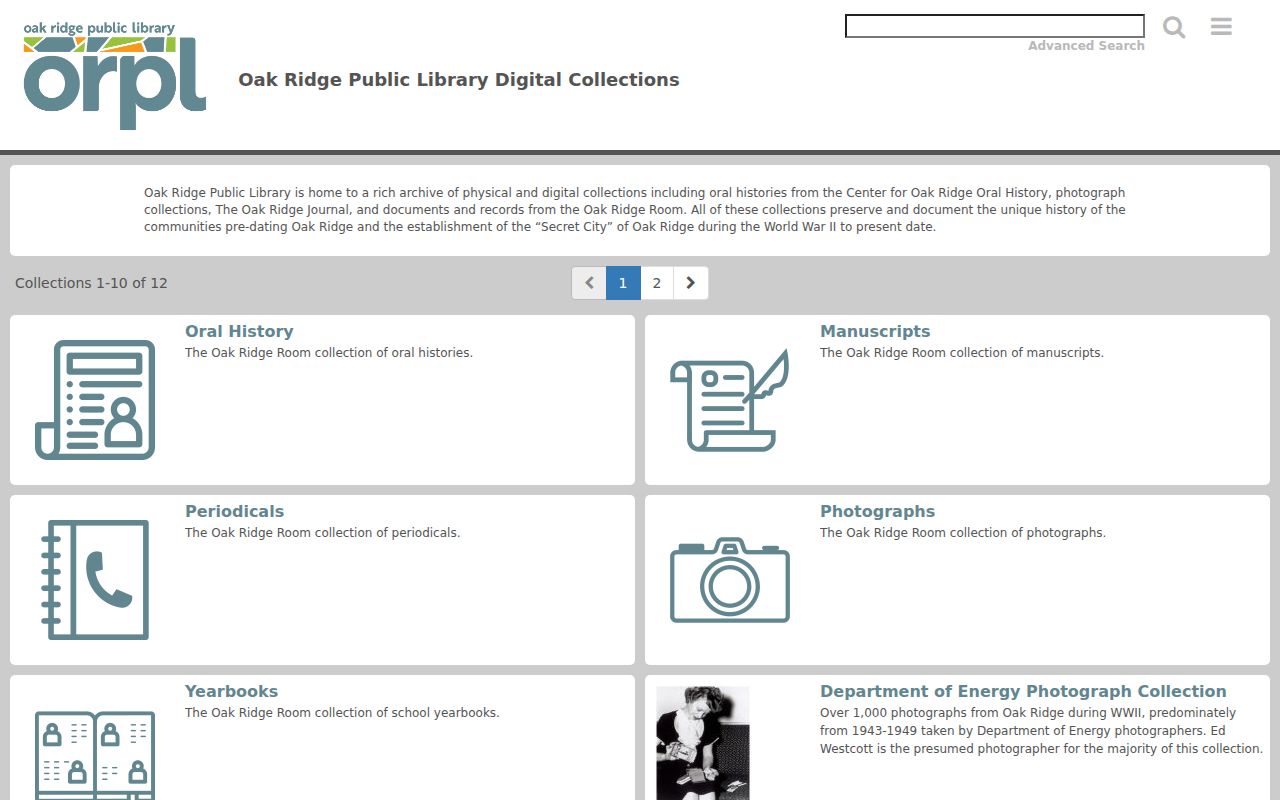
ContentDM is a strong first stop for item-level clues, while the Oak Ridge Room remains the route for staff help with unpublished local-history coverage.
Oak Ridge Hospital Directory Record
A 1945 item in ContentDM, titled Directory of Oak Ridge Hospital personnel, is a verified local directory-style record. Its metadata identifies the Oak Ridge Hospital or Clinic, gives the date, describes the wartime institution, and places the item in the library's collection. It can link a name to an organization and a time. It does not establish that every person in Oak Ridge appeared in the item.
The inspected record does not supply verified image-level address, telephone, role, or abbreviation fields. For that reason, no generic entry format should be projected onto it. Treat this institutional directory as one carefully defined source and pair a name with a deed, newspaper notice, oral history, or another record appropriate to the question.
| Title | Directory of Oak Ridge Hospital personnel |
|---|---|
| Date | 1945 |
| Institution | Oak Ridge Hospital or Clinic |
| Record form | Local institutional directory |
| Verified access | Oak Ridge Public Library ContentDM item |
| Unverified entry fields | Address, telephone, role, and abbreviation key were not extracted |
Reading Oak Ridge City Directory Entries
Later directory formats can be organized by last name, address, or telephone. The Library of Congress describes the reverse or criss-cross arrangement as the bridge from an address to an occupant. The verified Anderson County series is the safest local example of that arrangement. An alphabetical name listing and a reverse listing answer different questions, so note which half of a volume produced a result.
Because a general Oak Ridge entry with visible fields was not inspected, marks for ownership, family relationships, or abbreviations cannot be claimed for a local volume without viewing that volume. Photograph or transcribe the title page and any abbreviation key before extracting names. That preserves the exact context for a later comparison.
- Criss-cross directory
- A directory arranged by address or street, used to move from a location to the listed occupant. The verified Anderson County run covers 1989 through 1995.
- Householder index
- An alphabetical listing organized around a principal household name. Its presence and wording must be confirmed in the specific Oak Ridge volume.
- Abbreviation key
- The legend that explains shortened labels in a volume. No key was extracted from the inspected hospital directory, so local meanings should not be guessed.
Oak Ridge Criss-Cross Directory Years
The Library of Congress guide identifies an Anderson County address-directory run for 1989 through 1995 and specifically includes Oak Ridge and Clinton. That is a defined address window, not evidence of a complete local sequence before or after it. Ask the local library to confirm which physical volumes are available and whether a year is missing.
Reverse listings are useful when an old address is already known. They can point to an occupant name, then an alphabetical listing, deed, obituary, or newspaper item can test the match. A directory result alone does not settle ownership, family ties, or the exact length of residence.
Oak Ridge Directory Date Checks
Newspapers can help close the space between a directory year and a recorded deed. The Library of Congress catalog identifies The Oak Ridger with a 1949-current publication history, and the public library's digital collections identify Oak Ridge Journal material. Search a surname with a street, institution, or event date, then compare the notice with a directory or county record.
Marriage notices, obituaries, civic appointments, building announcements, and address references can narrow a date range. They are best treated as supporting evidence. A notice may use a shortened name or describe a former address, which is why a full citation and a second local source matter.
Trace Oak Ridge City Directories
A household trail works best when each source fills a defined gap. Start with a verified directory year or institutional record, then follow the name and address forward or backward only when another volume is actually available. For the most reliable historical reading, pair printed directories with the federal census, parcel descriptions, and local notices rather than forcing a continuous story from isolated entries.
- Write down the exact name, street, title, year, and page or digital item identifier from the first record.
- Check the next confirmed directory-style source, noting spelling changes, a different street, or an institutional affiliation.
- For an address in the 1989-1995 window, ask for the Anderson County criss-cross volume and record its result separately.
- Pair the relevant period with the public 1950 federal census when it fits the era, and keep its enumeration geography distinct from a later city address.
- Use a deed, probate file, obituary, or newspaper notice to test a move, death, or family connection.
A name disappearing from a volume is not a conclusion. The person may have moved, appeared under a different form of the name, been outside the volume's scope, or fallen into an unverified gap. The record date and the date accessed should remain separate in research notes.
Oak Ridge Directory Census Pairing
Federal census access follows a 72-year release rule. The 1950 census is public, while 1960 is scheduled to open in 2032. Census geography may not match later city limits or county boundaries, especially in a city whose records cross Anderson and Roane counties. Use the enumeration place as it appears in the census, then compare it with a parcel description or dated address.
Oak Ridge's documentary layers run from early county books to wartime community collections, printed sources, deed images, and modern city systems. Keeping each layer in its own period prevents a current map label from being treated as an older household location.
Oak Ridge Historical Source Leads
The Anderson County Historical Society, formerly the Pellissippi Genealogical and Historical Society, provides a community research lead from Clinton. Its holdings include publications, The Pellissippian, indexes and tables, First Families certificates, and a descendants project. The society is not the government custodian for every original record, so use its leads to locate the appropriate archive, recorder, or library source.
The supplementary Anderson archive index reports warranty deeds from 1802, probate material from 1830 through 2000, and several county court series. Those descriptions are useful starting points, but original custody and completeness need confirmation before a date range is treated as final.
Visit the Anderson County Historical Society and Pellissippi research site for its publications and contact route.
The historical society can point a family researcher toward local indexes, while the archive or library verifies the original record and its coverage.