
Oak Ridge Address History Sources
Previous residents of an Oak Ridge address can appear in different records for different eras. Begin with the county-side parcel and a current deed, then work backward through the appropriate index. Directory-style sources add an address-to-occupant layer, while census, notices, probate, and planning records can test dates and connections. A source that is online today may describe only a portion of the historical record, so access date and record date should both be noted.
| Record trail | Documented years | Where it is kept | What it can establish |
|---|---|---|---|
| Anderson deed index and images | 1990-present, complete | Andersondeeds / American Land Records | Transaction parties, recording placement, and images |
| Anderson older deed leads | Warranty deeds reported from 1802 | Archives, recorder, and Clinton Public Library | Earlier party names and legal descriptions |
| Roane deed records | Records date to 1801; online cutoff unstated | Roane office or paid online service | Backward chain after coverage is confirmed |
| Anderson criss-cross directory | 1989-1995, including Oak Ridge | Library of Congress guide and local library | Address-to-occupant lead |
| Oak Ridge City Directory | 1960 title and year verified | ORPL and genealogy lead | Historical name and address clue |
| Federal census | 1950 public; 1960 opens in 2032 | National Archives and library databases | Household and enumeration geography |
| CityView permits and planning | Historical range not stated | Oak Ridge CityView | Address, parcel, or project chronology if public |
For a recent Anderson-side transaction, start with the online deed index. For a Roane-side question or an earlier date, treat an empty online result as an access question and ask whether the relevant book is digitized, available on a terminal, or still in physical volumes. The directories and census are supporting layers, not replacements for a recorded instrument.
Oak Ridge Parcel Trail Begins
Before tracing prior occupants or owners, record the exact modern address, county, parcel identifier, and legal description. Keep both the assessor mailing address and the situs address. The situs identifies the physical parcel, while a mailing address can point elsewhere. Tennessee Property Assessment Data and the county assessor are useful for the parcel starting point, but the current name on a tax record is a beginning rather than an endpoint.
An address-only search may fail when an older instrument relies on a tract description, subdivision name, lot and block, former street name, or earlier number. A legal description and the last known recording reference give the recorder or library staff something more durable than a street number alone. Those details also help distinguish two places with similar address forms.
Use Tennessee Property Assessment Data or the county assessor to locate parcel details before starting the deed trail.
Oak Ridge Past Owner Deed Chain
On the Anderson County side, the online deed index and images are complete from 1990 to the present, and the service began online on March 24, 1997. Those are different facts. The service-start date does not limit the date of documents in the complete online range. Locate the current owner's most recent acquisition deed, then follow the transaction backward by treating the seller on that deed as the earlier buyer to locate.
- Confirm the parcel, county, current tax-roll name, mailing address, situs, and legal description.
- Find the most recent deed in which the current party is the grantee, then record the book and page or instrument number.
- Use the grantor from that deed as the grantee in an earlier transaction search, while matching the legal description.
- Repeat the backward sequence and save each verified recording reference rather than relying on a copied name alone.
- When the online trail ends, take the last reference and legal description to the recorder, archives, or Clinton Public Library microfilm route.
- Grantor and grantee
- The grantor transfers an interest in the recorded transaction. The grantee receives it. Reading both roles lets a deed chain move backward.
- Chain of title
- A dated sequence of recorded transactions connected by parties and the same property description. It is not a list of every person connected to the address.
- Legal description
- The property wording in a deed, often using a lot, block, subdivision, tract, or boundary description. It can remain useful when a street number changes.
- Situs address
- The physical location of a parcel, distinct from the address used to receive tax mail.
Open the Anderson deed-index access page to begin the documented online route.

The Anderson index supplies a defined online window, while the archive and library remain the fallback for the earlier stages of an Oak Ridge title trail.
Oak Ridge Two-County Deed Routes
Oak Ridge crosses Anderson and Roane counties. That local geography changes where an address history belongs. Anderson-side parcels generally lead to the Anderson Register of Deeds, assessor, clerk, and court offices. Roane-side parcels lead to Roane's corresponding offices. Municipal services remain citywide, but a county record follows the parcel jurisdiction rather than the city name.
Roane County says its records date to 1801 and are being digitized. The online route is subscription-based, or the researcher can use the Register of Deeds office at 200 E Race Street, Suite 6, Kingston. No official online cutoff was published. Ask whether the needed book is digitized, available at a terminal, or only in physical form. Military discharges are retained there, but they are not a normal source for a deed chain.
Review the Roane County Register of Deeds access information before relying on an online absence.

Roane's long record history is valuable, but the unreported online cutoff means office or subscription access may be needed for a particular volume.
Oak Ridge Former Address Clues
Address continuity is a serious issue in Oak Ridge's wartime and postwar growth. The city adopted an Addressing and Street Naming Policy in 2024 and maintains an Official Street Names and Address Master Plan, block numbers and address ranges, all-parcel records, and a valid street-name inventory. The policy permits new addresses through planning, site, and plat review and allows changes to numbers or street names.
No official chronology of historical renumberings or renamed streets was located. Do not assume that a current number is the same historical location. Search the street name, an adjacent owner, subdivision or lot, plat, parcel map, and legal description. Planning can be asked whether a current address superseded an older one, but that question should include the old form and the parcel details.
Oak Ridge Sanborn Map Evidence
Sanborn fire-insurance maps can help date a street layout, building footprint, construction material, and named institution. The Library of Congress is the official national access point for the maps. Exact Oak Ridge sheet years were not located in the research, so no local map year should be assumed without checking the library or Library of Congress catalog.
A Sanborn sheet is physical-layout evidence. It can help determine whether a building or street arrangement existed at a given time, but it does not prove that a particular person lived there. Pair a map with a deed, directory, newspaper notice, or census entry before connecting a name to an address.
Oak Ridge Prior Household Records
Owners and occupants are different questions. The Anderson County criss-cross run for 1989 through 1995 can connect an address to a listed occupant, while the 1960 Oak Ridge City Directory is a verified title and year rather than a verified full run. The 1945 Oak Ridge Hospital personnel directory and oral histories can add local wartime context for a named person. The historical collections themselves are described on the Oak Ridge city directory page.
Oak Ridge Room staff can help locate directories, oral histories, yearbooks, photographs, vertical files, Sanborn maps, and obituary indexes. Clinton Public Library identifies county microfilm and newspaper groups. Call with the address, former names, subdivision, lot or block, approximate build date, and the name being researched. No official house-history how-to or complete local service list was found, so staff assistance is the documented route.
See the Clinton Public Library genealogy resources for the county microfilm and newspaper fallback.
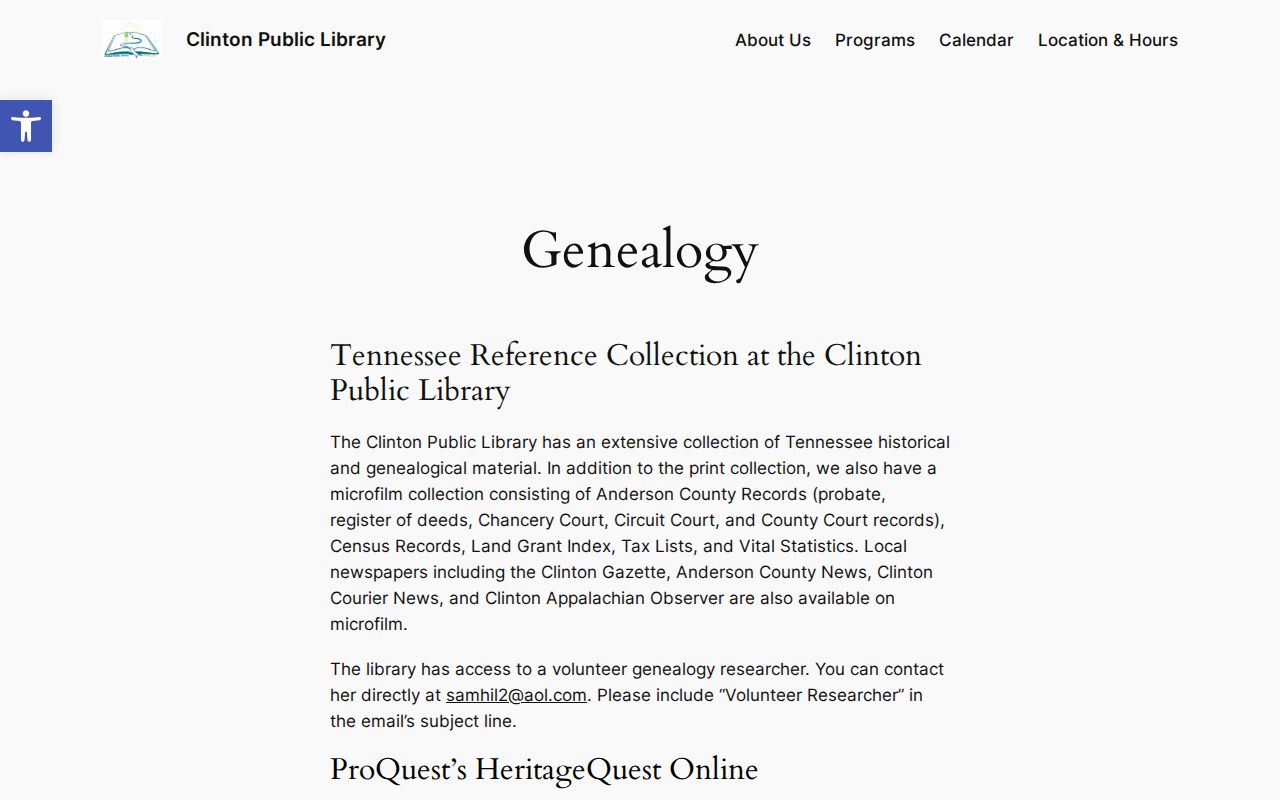
Clinton Public Library can bridge an Oak Ridge address to Anderson County deeds, probate, tax, census, and local newspaper materials when the online trail ends.
Oak Ridge Census Date Pairing
Pair a directory or address lead with the census only when the dates make sense. Federal images are public through the 72-year rule: 1950 is available, and 1960 is scheduled to open in 2032. Census geography can differ from a later Oak Ridge address or city boundary, so preserve the enumeration location exactly as recorded before comparing it with the parcel description.
- Start with a dated address or directory-style clue and write down the precise year and source.
- Use the nearest public census for the era, then record the household and enumeration geography as shown there.
- Compare street, parcel description, middle initials, relatives, organization, and date before treating two entries as the same person.
- Use a deed or newspaper notice to bridge the years between the census and directory-style source.
- Criss-cross directory
- An address-ordered directory that can provide an occupant lead. The documented local series covers 1989 through 1995, including Oak Ridge and Clinton.
- Enumeration district
- The census area's organizing label. It identifies the census geography, not a later municipal boundary or parcel.
Oak Ridge Notice and Probate Ends
The trail can close with records that explain a change in the property or the household. A recorded deed, tax assessment change, newspaper notice, probate file, or obituary may narrow a date. A deceased owner's estate can name heirs or an executor, while an obituary can connect a former address and family. These sources answer narrower questions than a deed, so label the evidence for what it actually says.
The Oak Ridger is cataloged from 1949 to the present, and Oak Ridge Journal material is identified in local digital collections. Search an event date, street, institution, and surname together. For earlier Anderson sources, the archive index reports probate and estate material from 1830 through 2000, but original custody and completeness should be confirmed before relying on the range.
Oak Ridge Previous Residents, Used Lawfully
Address-history research is suited to family history, a personal property story, estate questions, and civic curiosity. It should rely on records that are lawfully available and respect the limits of each custodian. A deed identifies transaction parties, not every person connected to a location. A directory or census entry also needs date and place checks before it supports a conclusion.
Personal-use limit. Use Oak Ridge address records for lawful personal research, and do not use a result to harass, stalk, or track a living person.